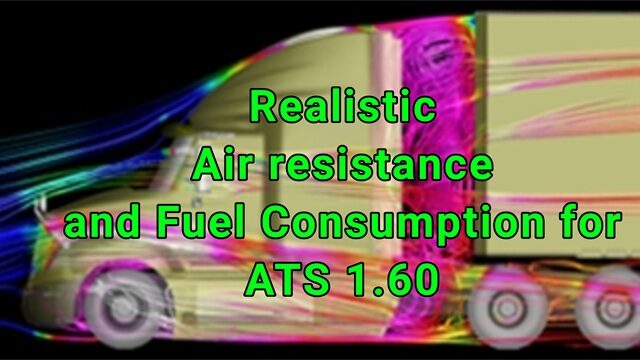
In update 1.58, the developers broke the air resistance parameter. This mod makes it realistic again and aims to restore real fuel consumption.
I need feedback on how the mod behaves at different speeds and with different loads. This is my first physics mod. I usually drive above 75 mph and I was annoyed when fuel consumption became noticeably lower than real-world values. At the moment, the mod is mainly tuned for those speeds.
Can be also downloaded on steam:
https://steamcommunity.com/sharedfiles/filedetails/?id=3790098169
Credits:
author: darkestdragon24
DOWNLOAD 31.8 KB
Sponsored links
No problem. At least there is more of a wind than before. I’m running it and I do notice a difference in fuel mileage and getting up to speed.
No problem it can’t be made more true to life. You did the best you could with what ATS is.
My thanks for this mod. As being an ex trucker I’ve often wondered why SCS hadn’t done anything about this. We can see there’s some sort of wind blowing in ATC but it never had any effect in the simulation on the trucks.
Imagine the wind blowing trucks off the road or tipping them over like I’ve seen in California in real life. And I’ve been in it with a loaded truck. I ran next to a guy who was empty just to keep him from being blown off I-60 heading west.
Thank you for the comment and the idea. It’s unlikely to be possible within the engine created by SCS, but I’ll look into the files to see if something can be done. The developers made air resistance this way because of their agreements with companies; within the framework of this game’s interconnected systems, it’s the simplest way to make fuel consumption lower or higher.
I checked all the files I could reach. The only thing I found was tree animations and similar effects. Unfortunately, in ATS wind exists only as an animation.
Since the air resistance has become realistic, accelerating a truck above 75 mph is now harder, especially with a load. The mod has the strongest effect at higher speeds: the difference in fuel consumption between 65 and 80 mph becomes noticeable, and the driver has to find a balance between delivery time and fuel costs. As a result, the most profitable speed becomes the one that most real truckers actually drive.